Article: The Mid-Century Mood: How to Give Your Home a 1950s–70s Soul Without Making It Feel Dated
The Mid-Century Mood: How to Give Your Home a 1950s–70s Soul Without Making It Feel Dated
There is something irresistible about a room with Mid-Century Modern soul.
Perhaps it is the warmth of walnut furniture, the confidence of burnt orange or the way a bold geometric print can make an otherwise quiet room suddenly feel alive. The style is nostalgic without being precious, sophisticated without being formal and playful without losing its sense of calm.
But creating the look today is not about turning your home into a perfect 1960s time capsule.
The most captivating modern interiors borrow the mood of the era—the colour, optimism, craftsmanship and fearless approach to design—while leaving enough breathing room for the home to feel contemporary.
Here is how to capture that balance.
Begin with the piece that sets the mood
Every memorable room needs a focal point.
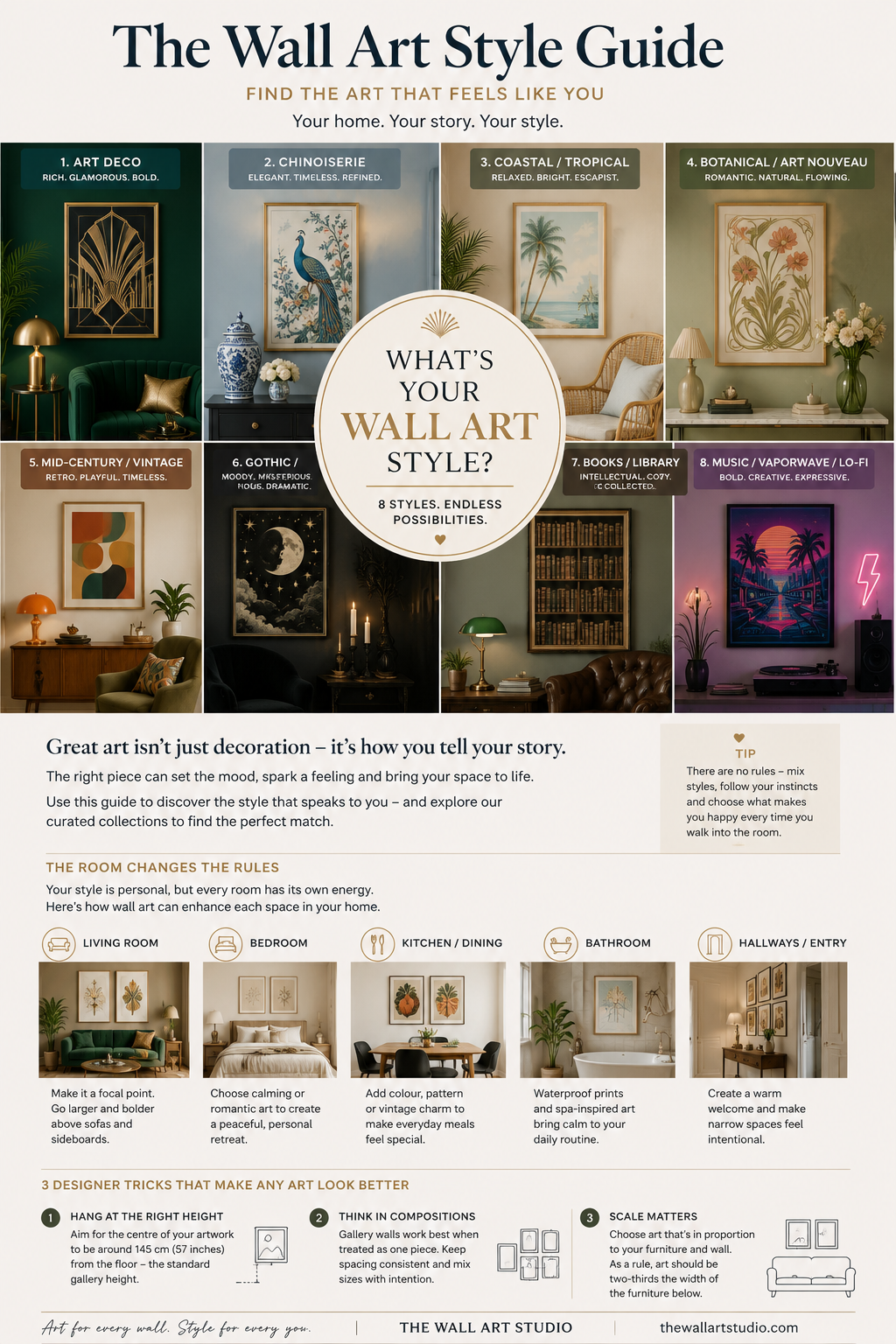
In a Mid-Century Modern interior, that might be an architectural chair or a beautifully shaped sideboard. However, wall art is often the simplest and most effective place to begin because it can establish the room’s entire colour story without requiring a complete redesign.
A large sunburst, abstract composition or retro botanical piece introduces the character of the era immediately. Once the artwork is chosen, its colours can be echoed more subtly through cushions, ceramics, lamps or upholstery.
The aim is not to match everything perfectly. It is to create a visual conversation.
Our Mid-Century Modern Sunburst Wall Art, for example, combines burnt orange, ochre and rich brown tones. Placed above a walnut sideboard or near a caramel leather chair, it becomes the anchor that pulls the entire room together.
Explore our Mid-Century Modern prints and framed prints.
Choose colour with confidence
Mid-Century Modern colour schemes were rarely shy, but that does not mean every surface needs to compete for attention.
The easiest approach is to begin with a warm neutral base—cream, ivory, oatmeal or soft stone—and introduce two or three richer shades.
Classic combinations include:
- Burnt orange, walnut and warm cream
- Mustard yellow, olive green and natural wood
- Terracotta, teal and soft beige
- Caramel brown, ochre and charcoal
- Muted pink, rust and dark wood
These colours work particularly well because they feel grounded and natural. Even the brighter shades have an earthy quality, preventing the room from becoming overly loud.
If your chosen artwork contains several strong colours, allow it to be the boldest part of the room. Pick out just one or two of its quieter shades elsewhere rather than trying to repeat every colour.
Let shape do some of the work
The Mid-Century period celebrated shape: sweeping curves, sunbursts, arches, starbursts and strong geometric forms.
These motifs are particularly effective on the wall because they create movement without taking up any physical space. A rounded form can soften a room filled with straight-edged furniture, while crisp geometry can bring definition to a relaxed or neutral interior.
Look beyond purely abstract designs, too. Stylised plants, birds, architecture and desert scenes can all carry a Mid-Century feeling through their simplified forms and distinctive palettes.
The result should feel graphic, expressive and intentional—not busy.
Mix the eras
One of the quickest ways to make Mid-Century styling feel dated is to insist that everything comes from the same decade.
A more interesting room mixes old and new.
Pair a vintage-inspired print with a contemporary sofa. Place a modern ceramic lamp on a second-hand wooden sideboard. Add a sculptural chair to a simple room rather than filling it with an entire matching furniture suite.
This contrast allows every piece to stand out.
You also do not need an architect-designed 1960s house to make the look work. Mid-Century Modern artwork can add personality to a Victorian terrace, soften a new-build interior or bring warmth to a minimalist flat.
It is the tension between different periods that gives a home depth.
Add texture before adding more colour
When a room feels unfinished, the answer is not always another decorative object. Often, what it needs is texture.
Natural materials are central to Mid-Century Modern style. Walnut, teak and oak bring warmth, while wool, bouclé, linen and leather keep the room tactile and inviting.
Try combining:
- A warm wooden sideboard
- A softly textured rug
- Linen or woven cushions
- Glazed or speckled ceramics
- A statement print in a natural-coloured frame
- One or two leafy plants
These materials give bold wall art a calm, considered setting. They also prevent retro colours and patterns from feeling flat or overly themed.
Give statement art enough space
Bold artwork needs room to breathe.
A single large portrait piece can be more powerful than several smaller pictures competing for attention. Above a sideboard, fireplace or reading chair, it creates a clear focal point and allows the design to be appreciated properly.
Scale matters here. Artwork that is too small can appear disconnected from the furniture beneath it, even when the design itself is striking.
As a general starting point, aim for artwork measuring around two-thirds of the width of the furniture below it. This does not need to be mathematically exact, but it helps the arrangement feel balanced rather than accidental.
If you prefer a more collected look, choose two complementary pieces with a shared palette or visual rhythm. They do not need to be identical; the strongest pairings often have subtle differences.
Style it room by room
In the living room
Choose a confident statement piece and place it where the eye naturally lands when entering the room. Connect it to the rest of the space through one repeated colour and warm wooden furniture.
In the kitchen or dining room
Retro botanical designs, graphic food imagery and playful geometric prints work beautifully here. Kitchens can tolerate more energy and humour than quieter rooms, so this is an ideal place to make a bolder choice.
In the bedroom
Use softer versions of the Mid-Century palette, such as muted terracotta, olive, blush and cream. Organic shapes and botanical designs will create a gentler interpretation of the style.
In the hallway
A hallway is perfect for artwork with real personality. Because people pass through rather than remain in the space, you can choose something more dramatic than you might select for a bedroom or living area.
In a home office
Geometric forms, architectural imagery and strong abstract compositions can make a workspace feel more purposeful and creatively stimulating.
Print, framed print or framed canvas?
The right format depends on the finish you want to create.
A print offers the greatest flexibility if you already own a frame or want to choose one that coordinates with your furniture.
A framed print gives the artwork a clean, finished appearance and arrives ready to hang. Natural wood is especially effective in a Mid-Century room, while a black frame creates a sharper, more graphic contrast.
A framed canvas has greater visual depth and presence. It works particularly well when you want the artwork to feel like a substantial statement piece rather than a decorative finishing touch.
Browse our Mid-Century Modern framed canvas collection for a bolder, more dimensional finish.
Avoid the showroom effect
The best Mid-Century Modern rooms feel evolved rather than staged.
Leave some surfaces empty. Include objects that mean something to you. Mix special pieces with practical everyday furniture. Allow a contemporary lamp, a stack of well-loved books or an unexpectedly modern colour to interrupt the theme.
Your home should not look as though nobody has touched it since 1964.
It should look like your home—just with better curves, warmer colours and considerably more confidence.
A modern home with an old soul
Mid-Century Modern style has endured because it is more than a passing trend. Its combination of expressive artwork, natural materials and functional design creates rooms that feel both stylish and genuinely liveable.
You do not need to change everything at once.
Start with one piece that makes you feel something. Give it the space it deserves, borrow a few colours from it and allow the rest of the room to develop around it.
Sometimes, transforming a room really does begin with a single wall.