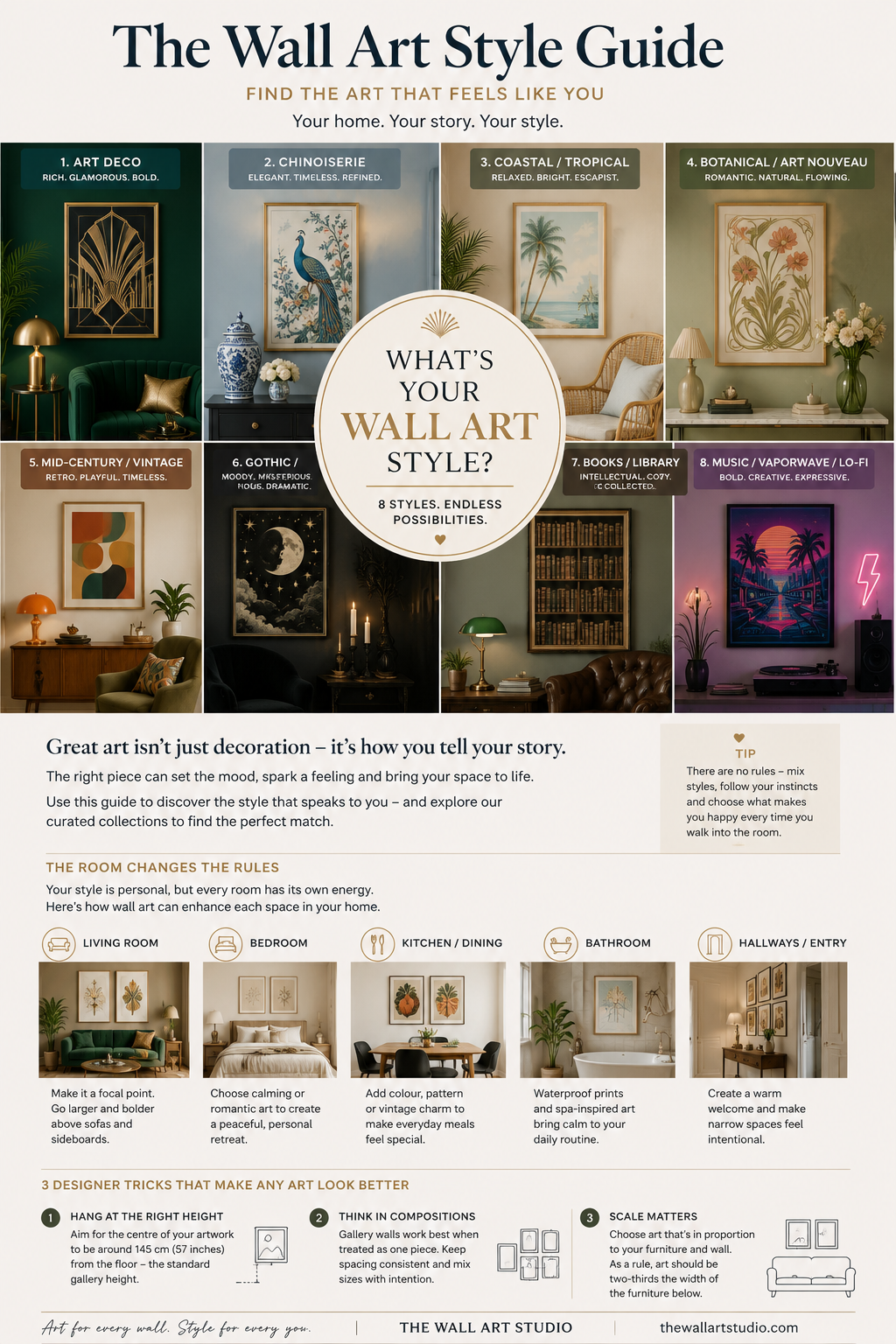
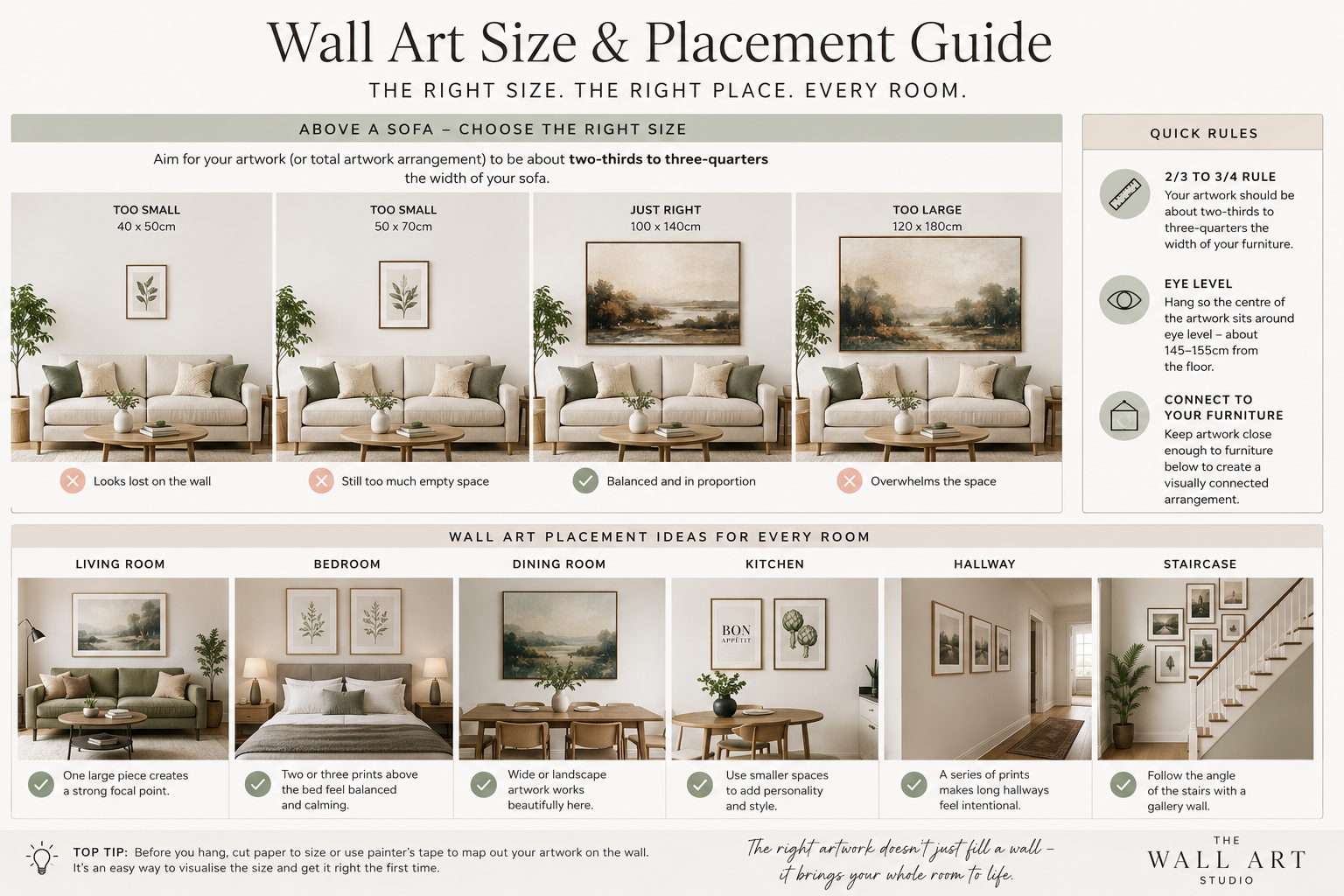
How to Choose the Right Wall Art Size and Placement
Choosing wall art is often the easy part. Deciding what size to buy and where to hang it can be much harder.
A print that looks perfect online can feel surprisingly small once it is hanging above a large sofa, while oversized artwork can overwhelm a narrow wall. The secret is to think about the artwork as part of the room rather than as something simply added to an empty space.
In this guide, we’ll look at how to choose wall art sizes and positions for different rooms in your home, from living rooms and bedrooms to kitchens, bathrooms and hallways.

Start With the Wall, Not the Artwork
Before choosing a size, look at the space where your artwork will actually hang.
Consider the furniture beneath it, the width and height of the available wall and how much empty space you want to leave around the artwork.
A common mistake is choosing artwork that is too small for the wall. While smaller prints can work beautifully in the right setting, a single small piece floating in the middle of a large empty wall can look disconnected from the rest of the room.
As a general styling guide, artwork positioned above furniture often looks most balanced when it fills roughly two-thirds to three-quarters of the width of the furniture below it.
For example, if you have a wide three-seater sofa, a larger landscape print, statement framed print or group of coordinated pieces will usually feel more proportional than one small portrait print.
Wall Art Above a Sofa
The space above the sofa is one of the most popular places for statement wall art.
Because the sofa is normally one of the largest pieces of furniture in a living room, the artwork needs enough visual presence to balance it.
For a minimalist look, try one large statement piece centred above the sofa.
For something more decorative, use two or three coordinating prints. A trio can create the impression of one larger piece of artwork while giving you more flexibility with the overall width.
You could also create a gallery wall using different sizes and orientations.
Whichever approach you choose, think of the entire arrangement as one piece. The combined width should feel proportional to the sofa rather than leaving the artwork looking lost above it.
Styling idea
If your living room already contains lots of patterns, cushions, shelving or decorative objects, one larger artwork can create a calmer focal point.
If the room is relatively simple, a gallery wall can introduce more personality and visual interest.
Choosing Wall Art for the Bedroom
The wall above the bed is another ideal location for artwork.
Your bed creates a natural focal point, so artwork positioned above it can make the entire room feel more finished.
Larger beds generally need larger artwork.
Above a king-size bed, consider a substantial landscape piece, a large framed canvas or a set of two or three prints.
Above a smaller bed, a single portrait or landscape piece may provide enough impact without overwhelming the space.
Try to keep the artwork visually connected to the bed. Hanging it too high can create an awkward gap between the two.
Styling idea
For a relaxed bedroom, choose artwork that complements colours already used in your bedding, curtains or soft furnishings.
You don't need to find an exact colour match. Repeating just one or two tones from elsewhere in the room can help the artwork feel intentional.
Wall Art Above a Console Table or Sideboard
Console tables and sideboards are perfect for creating styled areas within a room.
Here, your wall art can form part of a larger arrangement alongside lamps, plants, books, candles or decorative objects.
A large piece centred above the furniture creates a strong focal point.
Alternatively, try positioning artwork slightly off-centre and balancing it with a tall lamp or decorative object on the opposite side.
This can create a more relaxed, professionally styled appearance.
If you're using several pieces, vary the heights while maintaining enough visual connection for them to feel like one arrangement.
Choosing Art for the Dining Room
Dining rooms are particularly well suited to larger artwork because the walls often have fewer pieces of furniture competing for attention.
A large statement print or framed canvas can anchor the dining area and give the room a clear focal point.
Long dining tables also work particularly well with landscape artwork or a horizontal arrangement of multiple prints.
If you have a smaller dining area, consider a portrait piece on a narrower wall or a pair of coordinating prints.
Styling idea
Think about the atmosphere you want to create.
Bold abstract artwork can give a dining room a contemporary feel, while botanical, vintage, food-inspired or Art Deco designs can create a completely different mood.
Wall Art in the Kitchen
Kitchen wall art often needs to work around cabinets, shelving, doors and appliances, which means large uninterrupted walls aren't always available.
Instead of searching for one large space, look for smaller areas that could become features.
A narrow portrait print can work between cabinets and a doorway, while a pair of coordinating prints can transform a breakfast nook.
Artwork can also help define a dining or coffee area within an open-plan kitchen.
Food, drinks, botanical designs, vintage advertising-inspired artwork and playful prints can all introduce character without changing the kitchen itself.
Bathroom Wall Art
Bathrooms are often overlooked when decorating, but artwork can make them feel much more considered.
Smaller walls are ideal for portrait prints, pairs or compact arrangements.
Try artwork above a toilet, beside a vanity or on an otherwise unused wall.
You don't necessarily need traditional bathroom-themed artwork either. Abstract designs, botanical pieces, coastal artwork and playful typography can all work depending on the style of your space.
Hallways and Staircases
Hallways are perfect for artwork because they provide an opportunity to decorate without needing additional furniture.
For long hallways, consider a series of prints positioned along the wall.
Repeating the same frame style can help separate pieces feel connected.
Staircases are particularly suited to gallery walls. Rather than keeping every piece at exactly the same height, allow the arrangement to gradually rise with the staircase.
The overall collection should follow the movement of the stairs.
What About Large Empty Walls?
Large blank walls can be intimidating, but they also provide the greatest freedom.
You have several options:
- One oversized statement artwork
- A pair of large coordinating prints
- A set of three
- A structured grid
- A mixed gallery wall
Before hanging anything, map out the approximate dimensions on the wall.
Painter's tape can be useful for marking the outer edges of the artwork so you can see how much space it will occupy.
You can also cut paper to the dimensions of different prints and temporarily attach the pieces to the wall.
This simple step can prevent you from ordering artwork and then discovering that it feels much smaller — or larger — than you imagined.
How High Should You Hang Wall Art?
When artwork isn't positioned above furniture, aim to keep the centre of the artwork around eye level.
One of the most common decorating mistakes is hanging pictures too high.
When artwork is placed above furniture, it can usually sit a little lower so the furniture and artwork visually connect.
Rather than concentrating solely on measurements, stand back and look at the entire arrangement.
The artwork should feel like part of the furniture grouping rather than something floating independently above it.
Portrait or Landscape?
The shape of the wall can help you decide.
A tall, narrow wall often suits portrait artwork.
A wide wall above a sofa, bed or dining table often suits landscape artwork.
But you don't have to match the shape exactly.
Two portrait prints placed next to each other can create a wider overall arrangement, while three smaller pieces can fill a space that would otherwise require one very large artwork.
One Large Artwork or Several Smaller Prints?
Both can work beautifully.
Choose one large piece when you want a strong focal point and a clean, uncluttered look.
Choose multiple prints when you want to introduce several designs, create a gallery effect or fill an unusual space.
Sets of artwork can also be useful when you're decorating a large wall but don't want one oversized piece dominating the room.
The important thing is to consider the dimensions of the entire arrangement rather than the size of each individual print.
Don't Be Afraid of Bigger Artwork
If you're deciding between two sizes, think carefully before automatically choosing the smaller option.
Wall art often appears much larger when you're looking at measurements on a screen than it does once it's placed on a wall.
In a spacious living room or bedroom, a larger piece can make the room feel more intentional and finished.
The aim isn't necessarily to fill every centimetre of available wall. You still want breathing space around your artwork.
But your artwork should have enough presence to feel as though it belongs there.
Make Your Wall Art Part of the Room
The best wall art doesn't simply fill an empty wall, it helps bring the room together.
Look at the shapes, colours, furniture and decorative details already present in your space and consider how your artwork could interact with them.
A bold piece can become the focal point of a neutral room. A softer design can bring calm to a busy space. A carefully positioned group of prints can transform an otherwise forgotten corner.
Most importantly, choose artwork that you genuinely enjoy looking at; interior trends will change, but your home should still feel like yours.
At The Wall Art Studio you can explore wall art for every room and decorating style, with prints, framed prints and framed canvas designs available to help you find the right piece for your space.
Whether you're filling a large living-room wall, adding the finishing touch above your bed or transforming a forgotten corner, the right artwork can completely change how a room feels.